Conversational Analysis of Chat Room Talk PHD thesis by Dr. Terrell Neuage University of South Australia National Library of Australia.
THESIShome ~ Abstract.html/pdf ~ Glossary.html/pdf ~ Introduction.html/pdf ~ methodology.html/pdf ~ literature review.html/pdf ~ Case
Study 1.html/pdf~ 2.html/pdf~ 3.html/pdf~ 4.html/pdf~ 5.html/pdf~ 6.html/pdf~ 7.html/pdf~ discussion.html/pdf ~ conclusion.html~ postscipt.html/pdf~ O*D*A*M.html/pdf~ Bibliography.html/pdf~ 911~ thesis-complete.htm/~ Terrell Neuage Home
Terrell Neuage Britney Spears chat CASE STUDY 3
Last
edited Wednesday, October 23, 2002
Case Study
1, 2, 3, 4, 5,
6,
7
Glossary Home Bibliography Emoticons
THESIShome 911
Chat used
in this Case Study is at http://se.unisa.edu.au/a3.html
Terrell Neuage
Britney Spears chat CASE
STUDY 3
CS 3.3.1.3 3D virtual chats and icons
CS 3.1 Introduction
In Case Study 1, using analysis drawn from Reader-response theory, I explored the duel role of authorship and reader and argued that the writer needed to be the reader of the text in order to contribute meaningful discourse. The author does not have to read in order to write or ‘speak’ in a chatroom, as he or she could just enter a chatroom and enter text into the chatroom, then leave. However, for shared discourse the writer has to read to produce a “response worthy” response. Chatrooms are, to this extent, dialogic. But that definition alone cannot cover the intricacies of chatroom discourse. In Case Study 2 the technology that makes chatroom discourse possible was introduced. Computer-Mediated communication (CMC) involves the study of the process of using computers to exchange information. However, without significance being applied to the characters on the screen during some process of reception, they cannot have a purpose. In this case study I look at how meaning is read from keyboard characters and iconic representatives and especially in the textual configurations used in Chatrooms, which often cannot be read as traditional text. The current CMC keyboard also now enables the user to upload an image which can be used as a representation of him or herself, as shown in Figure 4 CS 3:1 below, or as a visual “cue” or “prop”, in the theatrical sense. Analysis of chatroom practice and communicative “production and reception” thus requires a visual as well as verbal-textual analysis.
As I argue throughout my case studies, here the only way to identify intent in the chatroom is through attempting to identify what the chatter is doing in the room. The only cues that are provided are the utterances and the username. For example the chatter with the username <guest-MoreheadCityNC> is telling people that he or she has something to do with Morehead, North Carolina. Or <IMFLOYD> who was a chatter in the Hurricane Floyd chatroom discussed in Case Study 1 is saying that he or she identifies with Hurricane Floyd, and <Pizza2man> in the baseball chatroom I discuss in Case Study 7 identifies with baseball player Mike Pizza who plays for the New York Mets. Sometimes the username helps with identifying the intent of the person in the chatroom, in that the conversation of the chatter is often reflective of the username, in a personal or miniaturised version of the “celebrity-identification” used for the entire chatroom for Case Study 3.
What then might we expect from the chat of a group self-selecting into a Britney-identified chatroom? I saved 70 turns from this chat in March 2000, (appendix a3 http://se.unisa.edu.au/a3.html). At the time I knew little about Britney Spears except that she was another pop idol of children. I chose this particular chatroom at random out of a list of thousands on the popular Talkcity chat server, at a period when it was among the top of a search engine’s (Google) selections.
I will use semiotics alongside semantics and pragmatics to introduce a socially embedded reading of chatroom communication that is however, because it is based on an agreed translation, still regarded as a symbolic activity.
CS 3.1.1 Questions
‘Can a celebrity’s name as title of a chatroom create a difference in dialogue in chatrooms?’
My first question in researching the dialogue in this chatroom cannot be answered by any form of statistical analysis. People pass in and out of chatrooms, and unless there is a popup box with questions to answer – and some constraint on the honesty or accuracy of replies - there is no way to know who the chatters are, or why they are in a particular chatroom. Even with forms put on a site for people to answer there is no way of knowing whether the answers are accurate, as anyone can put in any information they wish at any time (Danet, 1998, Bromberg, 1996, Turkle, 1996). However, because the chatroom in Case Study 3 had the name of a celebrity and could be presumed to be limiting the group likely to find the chat topics appealing, the possibility was produced for an open or empirical study of whether such a limited group might display special discursive or chat-behavioural characteristics, exclusive to such a self-selected group; I posed the question, ‘Can a celebrity’s name as title of a chatroom create a difference in dialogue in chatrooms?’
To some extent this proved to be a naïve question. Before I entered this chatroom and copied the log for the ten-minute 70 turns discourse, I believed the talk would be solely about the person whose name the chatroom bears; ‘Britney Spears Chatroom’. An extensive and growing literature of fan culture suggests however that this is rarely, if ever the case (Jenkins, 1992, Modleski, 1982, Baym, 1993, 1998) The very role of the celebrity in identity formation (Lewis, 1992, Schickel, 1985, Giles. 2000) suggests that much of the talk in fan discussions will be about life and lifestyle for the devotee. Work on use of soap opera texts by Modleski (1982) and Mary Ellen Brown (1994) shows adult audiences creating continuities between the narratives and characters of the serials, and their own and their friends’ lives or personalities. Buckingham in the UK (David Buckingham 1987, p. 36) and Seiter (1989) in the US show the same practice among child audiences. Chat in a Britney Spears-identified room is thus more likely to be creating a subcultural reference to delimit the potential group not by the desire to discuss the named idol, but to discuss the full range of life experiences and issues relevant to the style-culture-identified social subgroup ironically defined by Britney Spears as a music performer and fashion /lifestyle leader, within a certain age/gender cohort (see Hebdige, 1999, Appadurai, 1996).
this second question is too directive. You will need to ground it in some way before introducing it. WHY might you suspect this and go looking for it? You could perhaps introduce and argument on “excessive levels of emotional expressiveness” in young female fan beahviours, and especially within the cult of Britney. This would mean 2-3 pages on fan behavioiurs generally; specialist studies of young girl fan groups, and some review on the specific positioning of Britney Spears within the contemporary music/fashion scene. Otherwise, you will have to let the use of emoticons “emerge” as an observed significant feature as you work through the site – then examine it BECAUSE it is excessive, or distinctive in some way. OK? You choose!)
The second research question I have posed asks: ‘are emoticons used more frequently in a youth orientated chatroom than in an ‘adult’ chatroom?’ I have compared the use of emoticons and abbreviations in the seven case studies I have discussed as well as several other chatrooms (see ‘comparison tables” http://se.unisa.edu.au/tables.htm) I have used as examples in this thesis, to attempt to answer this question. I will elaborate on these two questions and what I have found from them in the discussion of this case study below.
CS 3.1.2 Britney Spears
From statistics of her album sales and appearances, pre-adolescents make up the bulk of Britney Spear’s fan base[1]. I have used this chatroom as an opportunity to observe whether there are differences in ‘talk’ in what I believed to be an adolescent chatroom, from language used in adult orientated chatrooms, such as that used in case study 1, the emergency ‘storm’, or ‘911 chatrooms’, or a chat on 3D computer modeling discussed in case study 6. It is of course impossible to know the age or the gender of anyone online in the current textual based chatrooms, (view: WHO: Working to hault online abuse: http://www.haltabuse.org for statistics of viewing habits by gender and age, and http://www.clienthelpdesk.com/statistics_research/ for statistics of online viewing by gender and age) and therefore of interest to examine, as this case study does, whether there is any linguistic or semiotic evidence that topic-specific chatrooms attract certain age and possibly gender groupings.
CS 3.2 Methodology
CS 3.2.1 Theories
For this case study I have applied three linguistic analytical tools. Firstly, semiotic analysis or the study of signs, verbal or visual, (Chandler 2001, Saussure 1983, Eco 1979, 1986, 1995 and Julia Kristeva 1980, 1984) is used to search for recurrent meaning-structures or “significations” within “Britney chat”. In this chatroom I will discuss in particular the chatroom feature of emoticons, avatars and usernames. The Britney usage is compared to examples of iconic username from two other chatrooms, both 3-D chatrooms, to test for any distinctive features. Emoticons and abbreviations and the “identity” sign-tag of the chatter are features that are important to all chatroom discourse (Crystal 2001, Rivera 2002) I am however particularly interested here in the use of non-word representation, emoticons and abbreviations, seeking them in particular from a strongly “image-identified” user site, to optimize the chances of discovering how important visual or design-representational aspects of chatroom practice might be, as chat-room specific communicative behaviour. Semiotics is thus used as a method to uncover not just how ‘talk’ is accomplished in a chatroom, but how far chatroom “talk” generally may be said to include a broader than usual repertoire of representation.
Secondly, I use pragmatic theory (Ayer 1968, Peirce 1980) to reveal a socially embedded reading of chat ‘talk’. Pragmatics[2] looks at the ‘meaning’ of an utterance, considered as part of a social system, and here I use this to focus on how the various communicative items in chatrooms; emoticons, abbreviations and misspelled words as well as chat utterance sentence structures (CUSS)[3], are used within a delimited linguistic or a chat society. And thirdly I use semantics, (Korzybski 1954,Chierchia and McConnell-Ginet 1990, 1995) which investigates the ‘meaning’ of a linguistic item, considered as part of a syntactic system, in terms of how the item, (in this case even an abbreviation or an emoticon), relates to something else.
CS 3.2.2 Transcription
In the Britney Spears chatroom analysis I have divided the “utterances” or chat-turns in ways promoting a clearer view of individual “styles” or identity-codings of participants. In the following tables in the appendix of CS 3 (http://se.unisa.edu.au/a3.html), table one (http://se.unisa.edu.au/phd/chat/britchat.htm) presents the types of phrases used, identified within pragmatic or “function” categories (i.e. greetings, answers, etc). Table two (see table one page) denotes abbreviation, emoticon use, and the beginning of threads of conversation, and in table three (see table one page) are the user names of the participants, separated to allow for careful examination of their usually multi-layered semantic codings. Table four (http://se.unisa.edu.au/phd/chapter5/table_4.htm) is the raw data: the chat threads as they occurred in real time, while table five (http://se.unisa.edu.au/phd/chapter5/table_5.htm) lists the utterances used without user name or other coding devices, to examine the emergent “conversation” as if it alone were the significant feature of participation (which this analysis inclines to presume it is not), Table six (http://se.unisa.edu.au/3-table6.htm) are the 297 words ‘captured’ in this chat sequential – in one paragraph. I have done this to discover if this was presented without the 70-turns would it make sense? For example,
lol loL missed ya too jenn..
while I was sleepin lmao ter plz stop Go for it baby b!!! I miss? hmm Scott?
Lmao... .?¯S¯?.?°¯Y¯°?.?·D·?. lol lol xoxoxox JuStIn well heather he going to
end it i just know it No Syd damn it meee no not ter lol hmmm mickey But i
think hes gf dont miss him that muc but well see what tomrrow brings
These sixty-seven words tell the same story as the sixteen-turns that it took to say this:
|
TABLE FOUR |
|
1.
/ /\ 1a. <SluGGiE-> lol |
|
2. / /\ 2a. <Mickey_P_IsMine>
LoL |
|
3.
/ /\ 9a. <AnGeL_GlRL> sits n da couch n holds her head.. missed ya too
jenn..while I was sleepin lmao |
|
3.
/ /\ 3a. <JeRz-BaByGurL> ter plz stop -OVERLORD walks over to miss
<amethyst_desire> and whispers sweet nothings in her ear |
|
4.
C/ /\above4a. <Paul665> Go for it baby b!!! |
|
5.
/ /\ 2b. <Mickey_P_IsMine> I miss? hmm Scott? Lmao... |
|
6.
/ /\ 5a. <guest-Wild-Just> .?¯S¯?.?°¯Y¯°?.?·D·?. |
|
7.
C/ /\06 6a. <Pretty_Jennifer>lol |
|
8.
C/ /\06 7a. <baby_britney1> lol |
|
9.
C/ /\06 5b. <guest-Wild-Just> xoxoxox |
|
10.
/ /\ 2c. <Mickey_P_IsMine>JuStIn |
|
11.
/ /\ 8a. <IM_2_MUCH_4U> well heather he going to end it i just know it |
|
12.
/ /\ 6b. <Pretty_Jennifer> No Syd damn it meee |
|
13.
/ /\ 3b. <JeRz-BaByGurL> no hes
not ter |
|
14.
/ /\ 6c. <Pretty_Jennifer> lol |
|
15.
/ /\ 5c. <guest-Wild-Just> hmmm mickey |
|
16. / /\ 2d. <Mickey_P_IsMine>
But i think hes got a gf so i dont miss him that muc but well see what
tomrrow bringslol |
Table 4 CS 3:1 Sixteen turns in CS 3
Without showing the turns as shown above we do not have the reader-response mechanism involved to continue a communication. We can piece together the story of looking for love whether several people are speaking or one.
Table seven (http://se.unisa.edu.au/phd/chapter5/table7_8.htm) presents all of the words in the Britney Spears chatroom sample, separated into order of appearance in the chatroom, while table eight (http://se.unisa.edu.au/phd/chapter5/table_8.htm) presents the same the words in alphabetic order, as well as the number of occurrences for each word and word type. What this table shows is that ‘I’ or ‘I’ is used most often (18 times) with the abbreviation ‘lol’ (‘lots of laughs’ or ‘lots of love’) the second most used expression of the speaker. To provide for some continuity of categorization and at least some degree of comparative study between Case Studies, I have used the same coding as throughout the case studies (see 3.5 Protocol of a transcription methodology). The name attribution for each speaker, such as, <Luvable_gurl15>, is placed in brackets in the tables and within the discussion of this case study. The ‘speech’ of each speaker is only in brackets when in the discussion but not in the table.
CS 3.3 Discussion
As I am discussing semiotic analysis, the study of signs, as a way to analyze conversation in chatrooms I will also work in particular to show how avatars and icons can be used to represent the chat author. A chatter can have a textual username, or a picturographic representation of him or herself that has significance, albeit often only for the time he or she is in a particular chatroom. In figure 4 CS3:1, every time <Kokuen Lain Unigama> keys in a Chatroom Utterance Sentence Structure (CUSS) this image with the words, <techno teacher Kokuen’s daughter now leading the good life> below the image appear in front of any CUSS made by <Unigama>.


The dialogue, which I have only written down and could not save because chatrooms in java script cannot be copied to a word program, is simply about the chatter <Xian-Shin> speaking to another person who wants to telephone his or her mother. <Xian-Shin> answers the other person <Unigama>, with,

This illustrates how an icon dominates what is actually quite trivial and mundane information exchange – actually “phatic” or empty conversation to a viewer not familiar with the characters involved. However, at a deeper level, the level the two may be conversing at, the conversation may be filled with meaning.
This use of avatars and icons is thus qualitatively different from a chatroom that uses only usernames, such as the chatroom logs I used in this case study. There were no avatars and icons used in the Britney Spears chatroom whilst I was present. I am discussing avatars in this case study due to the theories I will borrow from to investigate this case study (See CS 3.2 Methodology). In this case study however, the signs, the representatives of the self, are variations of name, such as; <IM_2_MUCH_4U>, <Luvable_gurl15>, <SluGGiE->, <Mickey_P_IsMine >, <JeRz-BaByGurL >, <Paul665>, <guest-Wild-cust>, and <Pretty_Jennifer>. Britney chatters thus achieve some consistency with the icon-id, by using enhanced “punning” and linguistic ambivalence in their name-tags, not necessarily to hide their identity, but to emphasize his or herself at a particular time, and especially within the “sexy-good times” subcultural frame of Britney. Spears.
CS 3.3.1 Semiotics[4]
The importance of beginning with semiotics or a study of signs in this case study relates to the need for a focus on acquiring and passing on meaning within the intertextuality of chatroom ‘talk’ in order to establish signification in a text-based-chat. Chatroom dialogue is neither oral nor written, but semiotic (Shank 1993). It is not necessary to take turns as in oral communication and the many voices can be "heard" in parallel making chat dialogue a multilogue discussion (Høivik). To have significance, there needs to be the signifier or material aspect to the sign. In chatrooms, given the reduction of the physical “presence” of face-to-face real-life (rl) talk, and its further limitation in the chatroom dialogue box to relatively short text-utterances, there has been a strong compensatory move to creative “signing” through graphic and extra-semantic modes. Still limited at the dialogue-box level at least, to an alphabetic repertoire, supported only by the grammatical and punctuation signs of the qwerty keyboard, this newly evolved form of communication has produced both the emoticons, acronymic abbreviations, conventions on “expressive” representation – such as capitals = shouting; punning or ambiguous lexical selection, and especially abbreviated “cut’n’mix” forms combining many of the above, used as personal identifiers. (This last form, appropriating elements from multiple sources and “imbricating” them into a new fusion form, is interestingly close to the ideographic mode of Chinese writing, in which one element of a written word addresses its semantic or conceptual load, another its phonetic connections to similar-sounding words. (Hegal 1993; Hu 1996). The “reader” of Chinese must thus always read on multiple levels for every ideograph, relating it out to both its cultural origins and to its everyday use, to locate its meaning (Rosenthal 2000). At the same time, the name-terms of chat spaces are also close to the graphically-oriented “tags” of graffiti artists, whose stylized name or initials both teasingly conceal identity, and claim status by their positioning in public places, their over-drawing of other tags, and not least the artistry of their calligraphy. Both cases give some sense of the multi-functioning and multiple cultural engagement of chat-names).
Semiotic analysis thus enables this study to move beyond a linguistic base, into examination of the graphical and expressive modes used to compensate, and maybe beyond that, to create meaning in new ways, within the new “conversational” spaces of the chatroom – and particularly so in a chatroom of saturating expressiveness within identity work, as is the case with Britney chat. But to fully explore this drive to identity performance and exploration, such that it extends the actual communicative range of the “language” or coding system used, it is first necessary to examine which communicative functions are actually in use in the Britney Spears chat room, and to reveal which are dominant and recurrent.
CS 3.3.1.1 Emoticons
Emoticons in chatrooms are similar to manuscripts
for theatrical plays using bracketed text (Høivik 2000)
to describe actions or the actions of ones feelings. In most chatrooms, keyboard
letter combinations will produce an emoticon. The grid below shows that when :)
is typed on a keyboard, what appears in a chatroom, as well as in a Microsoft
Word document, is J. This shows that the emoticons known as
“smileys” are so well established that they are now automatically made when
keys are pressed. Some chatrooms even colour in the emoticons, these add
expressive coding. Three examples are given below;
|
Characters
typed on keyboard |
What
appears in Microsoft Word (2000+) |
What
appears in some chatrooms |
|
:) |
J |
|
|
:(
or :-( |
L |
|
|
:|
or :-| |
K |
|
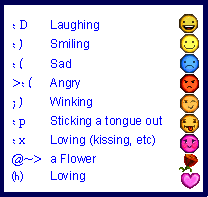

Table 4 CS 3:2
Emoticons
Just as in person-to-person conversation offline
(p2p-off), different dialects and accents develop in different text-based
chatrooms in CyberSpace. For example, emoticons are sometimes replaced by
asterixed gestures, such as *s* and *smile* or *g* and *grin* for the traditional :). I would postulate the
reason being that typing g is quicker than two keystrokes to produce :).
Of the seven case studies I have found the highest incidence of abbreviations (30%) and emoticons (6%) in the Britney Spears chatroom (see http://se.unisa.edu.au/tables.htm for a statistical comparison of the seven chatrooms). The dominant function of abbreviation use on this site I would suggest would be due to the assumed age group in this chatroom as the youth market is the primary push for shortened messages such as abbreviations and emoticons (Wrolstad 2002, Ocock 2002) as shown in the table below.
|
High
Interest in Applications of 3G |
|||
|
|
Western Europe |
Eastern Europe |
USA |
|
Total |
22% |
26% |
25% |
|
Under 25 |
37% |
30% |
45% |
|
25 to 34 |
27% |
26% |
26% |
|
35 to 49 |
19% |
25% |
27% |
|
50 and over |
9% |
24% |
10% |
|
("High
Interest" based upon a six-point interest scale, where ratings of 5 and
6 indicate high interest.) |
|||
Table 4 CS 3:3 Youth Market percentage of 3G
http://www.cellular.co.za/news_2002/060102-3g-market-research.htm
Many web analysts have considered the emoticon to be a “symbolic” form of communication (Herring 2002, Roberts-Young 1998, Reid 1991 and etc.) presumably in recognition of its distinctly graphic or visual form, as opposed to textual-alphabetic codes. But strictly defined, a symbol is a sign that has an arbitrary relationship to what it means. Its meaning is established within a particular cultural consensus, and any logical origins for the connection between the representation and the represented (in semiotic terms, the “signifier” and the ‘signified”, may even be lost in history.
To use an emoticon, however, is to give a meaning, usually to a feeling, through one or more existing keyboard characters. Emoticons may be “conventional”, in the sense of being available and consensually established within a given community of users – up to and including all web users, even across language groups (Churchill and Bly 2000, Norht 1994) – but they can also be “improvised” or created new, by the act of creative recombination or re-application to new circumstances. The keyboard thus becomes a way of adding expressiveness to the words typed into the dialogue box: restoring some elements of the expressiveness of vocalisation, facial expression, body gesture, or even handwriting fluency or emphasis, lost in the standardization of keyboarding and the remoteness and physical distantiation of the chat relation.
Because of the conscious choices from the available repertoire of expressively recombinant keystrokes that the emoticon culture offers, all presentational selections in dialogue box text entry become “significant” in semiotic terms: laden with potential expressive meaning, beyond that of the semantic load of the words themselves. Nor is this semiotic “loading” always an extension of intensification of the semantic intention. Such elements as case selection, word-“fracturing”, deliberate mis-spelling, can act alone or in combination with emoticon elements, to create inversions, ironic effects, deliberate ambiguities, and entire sets of witty effects, calculated in their own right to influence their reader(s) – interlocuter(s). In other words, even the presentational elements of chat are pragmatically and semantically “significant”.
It has long been established in chat communities of all kinds that using capitals for every turn taking is considered” rude” – the equivalent of shouting (Reid 1991, Rheingold 1991, 1994). When an otherwise apparently experienced chatroom participant uses this form of ‘speech’ it is worth seeking an explanation. . In the Britney extract below, at turns 50, 53 and 57 <Luvable_gurl15> uses capitals - but there is no immediate indication as to why. She (or he) has only four contributions in this chat sequence: the first in lower case with the following three in capitals.
|
50.
<Luvable_gurl15> HEY PAUL IT IS ME HANNAH |
|
53. <Luvable_gurl15> NAD I WILL.....LMAO |
|
57. <Luvable_gurl15>
WAAAAA |
<Luvable_gurl15> is the only contributor in this ‘captured’ chat sequence to use capitals. This suggests that <Luvable_gurl15> does not see herself as part of the general discourse format of the chatroom, but has taken it upon herself to claim a stronger presence in this room, than that signified by the conventional smaller letters. Remember that in Case Study 2, examining an Instant Messenger room, one person had used capitals in all of his turn takings. That contributor always uses capitals in all his online writing, whether in a usergroup or in a chatroom or in email, because he professes to be a spiritual guru, and claims it as a sign of spiritual authority to use capitals (perhaps a reflection of the formal grammatical convention of the capitalisation of terms for God; Our Lord, the Saviour, etc) Without similar access to knowledge of the motivations of <Luvable_gurl15> it is difficult to argue a similar case, or to propose that the person uses capitals in this chatroom because of her sense of self-importance. It is however possible to analyse the functions of each contribution, and to reconstruct the communicative intentions of the lexical-semantic as well as semiotic-expressive selections the participant has made. In this example it appears for instance that in turn 50 the use of upper case is equivalent to shouting across a crowded room to get someone’s attention. <Luvable_gurl15> says <HEY PAUL IT IS ME HANNAH>. Her naming of her addressee, Paul; her indication of a past relationship which will lead him to recognize her without identification (“it’s me”), her addition of her own name (“Hannah”) and even her informal and colloquial demand for attention (“hey!”) all operate to mark her contribution out as having been made by a special participant. The capitalization thus, in this case, operates as an intensifier.
In a chatroom everyone is in the same room, operating in a mixed-conversational medium, in which individual contributions – especially from those just joining an existing set of threads, can easily be overlooked. The conversation is no different in this respect than it would be if the participants were in a physical room together, in which noise levels were high. The graphic equivalent of shouting becomes a necessary strategy – and one underpinned by all of the other elements of the speech behaviour in <Luvable-gurl15>’s contribution.
That she subsequently, at line 53, displays a fluent use of chatroom ellipsis: <NAD I WILL.....LMAO> (laughing my ass off) in building her turns with complex acronyms, and then at line 57 creates a paralinguistic expressive utterance: <WAAAAA> in response to not seeing her friend and after addressing someone she apparently knows and revealing she is Hannah in line 50 <HEY PAUL IT IS ME HANNAH>.
This displays her as an experienced, even advanced chatter, who may simply be asserting her sense of a superior right to expression and response in a crowded chat space. But it is the dual signification she adopts: the representational load of her words and of her keyboarding, which produces her as this extra-assertive, extra-competent contributor.
This suggests that language within the chatroom is already
establishing a set of behaviours and techniques which are distinctively
different from conventional talk, at least in their capacity to add further
levels of communicative “signification” through the keyboards graphic-expressive
potential. Can this be explained, within the existing conventions of semiotic
theory? Whilst looking at the notion of ‘the sign’ I attempted to represent the
practices of a chatroom modeled on the American philosopher Charles S. Pierce’s
semiotic triangle, which consists of sign, concept and object as shown below
left. Pierce was attempting to capture the meaning relation between physical or
embodied experience, and the symbolic equivalent in language or in conventions
of graphic signage, by showing how the material object encountered by the
physical senses, and its symbolic coding within thought, are reunited in the
use of the SIGN, whether as word or as image. So too, with those words or
images used on websites, our newest forms of distantiated or alienated
communication. But what the chatroom experience has added, evolved from a very
rapid layering of countless numbers of user contributions and creations and
recognitions of “meaningfulness” or “signifiance”, (the potential to signify) is
the desire to render within this electronic equivalent of everyday
interpersonal chat the immediate and creative expressiveness of actual speech.
In
a chatroom the sign has duel significance. The emoticon and its associated
expressive techniques (i.e. avatars) are dually-significant as they double the
semiotic load of the chat which now carry a semantic and an
intentional-expressive load. Even at the simple level of the username or
graphic identity symbol, the selections carry multiple messages. Is <Pretty_Jennifer>
pretty? Is <AnGeL_GlRL> a girl? Is <Luvable_gurl15> really 15? But
they wish to represent themselves as this ‘other’. No surprise then that the
keyboarding of subsequent chat turns is enriched by the use of expressive forms
such as the emoticon, which represents a shortcut of expressed intent.
Emoticons are useful in chatroom discourse
because of the hurriedness of chat ‘speech’: the sheer text-entry-pace
required to maintain a seemingly natural conversational exchange, without
losing the complex interplays of spontaneous word projection and response. It
is much quicker to relay feelings with one or two presses[5] of the
keyboard than it is to explain whether one is sad or happy. At the same time,
as I will discuss below, the use of username and avatars or icons as symbols of
the chatter provides similar sorts of double signification, hinting to other
chatters the interpretive and relational positions to be taken up in
interactions with the speaker.
CS 3.3.1.2 BLISS
BLISS is a pictographical and ideographical symbol system
that was
developed 50 years ago by Charles K. Bliss and is still under development.
There are many countries involved with the development of BLISS with the world
headquarters being in Toronto Ontario.
They have an Internet presence at: http://home.istar.ca/~bci/index.htm. BLISS
was successfully used to support non-speaking persons in communication. BLISS
is the most widespread symbolic language worldwide. There are
three primary factors to bliss:
Key Symbols - A small
number of Blissymbols (less than 120) represent primary meanings or concepts
that are used repeatedly to generate additional symbol vocabulary. Key symbols
provide the key to deciphering any existing symbols and offer the potential for
creating new compound symbols. One can decode new symbols by identifying their
key symbol components and spelling the symbols to form a phrase. For example,
Person + feeling + positive + interested = friend





·
Language infrastructure - Blissymbolics
has its own grammar. Parts of speech are marked with indicators. mind (shape of
the top of the head),

 Indicators
give Bliss users the power to communicate verbs, adjectives, adverbs, plural,
tenses beginning with a basic concept found in a noun. This capability gives a
lot of power to knowing a small number of symbols.
Indicators
give Bliss users the power to communicate verbs, adjectives, adverbs, plural,
tenses beginning with a basic concept found in a noun. This capability gives a
lot of power to knowing a small number of symbols.
Generative - Each unit in a Blissymbol provides an element of meaning, a Blissymbols can be created by using a variety of strategies. The most important one is the combine strategy.
combine indicator + person + love + Blissymbol + combine indicator

Though emoticons as they are used in chatrooms, BLISS enthusiasts believe that the Bliss format will become more widely used in Online communication.
CS 3.3.1.3 3D virtual chats and icons
I
have included a discussion of virtual chats (Castel 2000; Barclift 2001;
Qvortrup 2000) in this chapter as the primary focus is on semiotics and the use
of the sign to signify. There were no avatars used in the Case Study with
Britney Spears and though they are primarily used for role-playing many
chatrooms let the ‘speaker’signify themselves through the use of an avatar.
Three-dimensional chatrooms change the discourse from reading just turn taking
utterances to adding a characterization of the ‘speakers’. In 3D virtual chats[6], avatars
(author as sign/symbol) as well as usernames provide the individual signature
of the chatter. The screen shot below shows a virtual chat room using avatars.
Many of the new chatrooms (those designed after 2001) do not use text. Instead
the chatter speaks into a microphone to create talk dialogue instead of writing
text onto the screen. However, in this study of pragmatics and semiotics I show
how even there the author/speaker is an important factor within the ensuing
conversation. The selection of the iconic representation of who they are,
sometimes changing at any specific moment, influences the response relation
within the conversational exchanges, in the same ways as the text-talk
discussed above. . There is a deliberate and purposive link between the avatar
and the intended “reading” or audio reception of the conversation.
A
feature of person-to-person offline (p2p-off) conversational analysis that is
different from person-to-person online (p2p-on) analysis is that the people who
appear in p2p-on conversation are not necessarily the same as their physical
originators. Whether it is through the username: <Pretty_Jennifer> or an
avatar, identity is disguised. In the Britney Spears Chatroom it can only be
guessed at what the gender is of the users. Of fifteen users names seven are
possible female, one is possibly male and seven are possibly either:
|
Possible
male |
Possible
female |
Either |
|
Paul665 |
JeRz-BaByGurL |
Mickey_P_IsMine |
|
|
Pretty_Jennifer |
guest-Wild-cust |
|
|
baby_britney1 |
IM_2_MUCH_4U |
|
|
AnGeL_GlRL |
msbbyblu12 |
|
|
MADDY_CICCONE |
Joypeters |
|
|
Luvable_gurl15 |
TYTAN-guest |
|
|
guest-hotgirlz |
buttercup20031 |
Table 4 CS 3:5
Male and Female names
Three-dimensional
chat with iconic (avatar) representation characterizes what the chatter
identifies with and in turn, wishes or hopes others will see him or her as. An
icon or picture of a female warrior, with a username of <lady-warrior>
may be an elderly male but others in the chatroom, and maybe the author of the
utterances using <lady-warrior> as a username himself, may believe that
the author is a young woman. How we are affected by pictures determines how we
interpret the utterances and how we respond.

Figure 4 CS 3:2 3D Virtual Chat screen http://www.cybertown.com/
For example, below several representative graphics of ‘the author’ in chatrooms show the liberty some chatters take in identifying themselves.
|
|
|
|



Figure 4 CS 3:3 Icons 3 representations
Just as we detected in the Britney chat above, the possible reference to a popular movie text “colouring” the talk relation, here we can clearly see media identifications used to convey or annex preferred “identity” to garner hoped-for responses.
To communicate such identity claims to others the chatter needs to do little to create a complicated virtual utterance. In the chatroom screen shown below, in the dropdown box on the left the chatter can chose an expression to modify what he or she is saying. Coupled with an emoticon such as a smiley face only a couple of actual words need be entered into the chat. Many sites let the user chose from a list of avatars but the self-made avatar gives originality to the user.
The avatar or icon appears before the text whenever the person ‘speaks’ in written text, for example;
...||Xian-Shin||...

Xian-Shin Icon avatar
CS 3.3.2 Pragmatics
Pragmatics looks at what the ‘speakers’ or writer are doing conversationally in a chatroom. At this point, a pragmatic study of chatrooms can show which keyboard character-manipulation (emoticons, letters, numbers) are being used to “switch” dialogue by double-loading its semiotic values, and so to position reception of the semantic load or subject matter the user is dealing with.
Pragmatics is the study of actual language use in specific situations. By looking at the factors that govern our choice of language in social interaction and the effects of our choices on others (Levinson, 1983; Nofsinger, 1991) we can calculate the speaker’s intentions from the utterances they produce. In studying chatroom practice, such consideration of the intended outcomes within reception of utterances must therefore include description and analysis of this double semiotic load: the semi-graphical components of the keyboarding, which similarly “positions” addressees to “take up” and respond to utterances in certain preferred ways.
Here I have represented the chat turns as they might appear in ordinary talk: that is, without the source attributions which appear on the scrolling chatroom dialogue box. This is of course how the “speaker” enters them – so is a means of capturing the “response” mode of interactive chat as its intentions are coded in – even if each addressee does have the advantage of receiving the contribution in a name attributed format (along with all of the non-addressees receiving the contribution in their mixed sequence scrolling in the open dialogue box). The removal of the name identifiers does however achieve the function of “remixing” the chat into physical talk-conventional turns, so indicating how far the respondent role (reader rather than writer) is crucial for continuity and reciprocity in this chat mode. Without the named attribution, the talk flows become incomprehensible and unmanageable.
|
WAAAAA |
|
Ok..
its cool. now your turn =p |
|
gurl
15 hannah?? |
|
asl? |
|
not
cool jenn...criez |
|
huh |
|
kev
are you there |
|
which
i duno how im failin science |
|
What? |
Table 4 CS 3:7 Chat flow words only no usernames
By consulting the Table with the user names included, it becomes possible to see the response interactions. Because these speech exchanges are so heavily invested with the types of additional semiotic loading outlined above, their semantic load alone conveys too little for us to reconstruct logical response-pairings, and so find the “threads” of conversation. While for instance the single interrogative <what?> could well be a response to the line above – a comment which cannot logically be made to engage any of the prior utterances, that <what> proves to be a response to the comment <not cool jenn…criez>, and thus becomes not a shocked exclamation (What!) but instead a semi-denial response inviting elaboration of an accusation: (What are you (unfairly?) accusing me of?)
While pragmatics can help us to reconstruct responses from the positioning work of their original proposition utterances, it can also help us to find if users are switching codes, or shifting the positioning elements of their utterances, according to the interactive and reactive development of their speech relation. Code-switching introduces socio-cultural information in context, which is retrievable through conversational inference (Gumperz 1982; Alvarez-Cáccamo 1990). As can be seen in the conversation below the dialogue is dependant on knowing what the other participants are saying.
|
57.
<Luvable_gurl15> WAAAAA |
|
58.
<Pretty_Jennifer>Ok.. its cool. now your turn =p |
|
59.
<Paul665>gurl 15 hannah?? |
|
60.
<Pretty_Jennifer> asl? |
|
61.
<AnGeL_GlRL> not cool jenn...criez |
|
62.
<Paul665>huh |
|
63.
<buttercup20031> kev are you there |
|
64.
<Mickey_P_IsMine> which i duno how im failin science |
|
65. <Pretty_Jennifer> What? |
Table 4 CS 3:8 Chat flow words and usernames
The
above table includes nine turns from seven different ‘usernames’. Unlike
person-to-person talk offline (p2p-off) where the direction of the conversation
can be followed by seeing who is speaking to whom, in person-to-person online
dialogue (p2p-on) it is difficult to establish
streams of interactivity. . The features of
p2p on create a new set of rules for interactivity. The degree
to which participants spend time “housekeeping” their engagement with a
particular respondent is clear from this 9-turn extract, where Paul (lines 59
and 62) tries to establish whether Luvable-gurl 15 (line 57) really is the
“Hannah” she claims to be – a surprised questioning achieved with the double
question mark and the paralinguistic “huh”, rather than in clearly established
semantic loadings.
Meanwhile
<Pretty Jennifer> at lines 58, 60 and 65 tries to establish contact with
an unidentified “newby” someone of whom she asks the very basic information
which operates in chatrooms as “so tell us all about yourself”: <asl>, or
“age-sex-location please…” Presumably in line 58 she is reassuring this new contributor
that she can go ahead: OK…it’s cool”, advising her on what to do next: “now
your turn…” But to get to this reconstruction of an exchange and so establish
its relational and intentional load (helpfulness and reciprocity) and
positioning of an expected response, we have had to we have had to make a
decision about a quite complex “code switch”, where <Pretty_Jennifer> has
moved into helpful instructional modality (<now your turn…”>, and into
very basic keyboard acronym coding (<asl>) and away from the presumably
less patient forms which have produced <AnGel-GIRL>’s comment at turn 61:
<not cool jenn…criez>. Here the reproof, plus the familiar abbreviation
of the name, and the representation of her own responsive feeling – along with
its youth-culture “z” terminal, builds a complex mix of socio-moral evaluation
in the content, and “mitigated” form in the address. This contribution thus
says something like “Pretty Jennifer we know each other well enough for me to
tell you that what you have just done is unacceptable – but I still like you
enough to call you by your pet diminutive name, use youth-in-group terms which
cement our shared sub-cultural bonding, and enact a mock-emotional response
which I know you will laugh at yet still use as a warning”. With 21 keystrokes,
including the space bar hits, she has achieved all that.
William
James, who wrote on the analysis of the structures of the stream of
consciousness accompanying thinking, envisaged pragmatism as “…a method of
settling metaphysical disputes that otherwise might be interminable.” (James
1907). James’s notion of streams of consciousness linking thought to thought
captures much the same seemingly random and discontinuous flow as chatroom
‘talk’. Chatroom ‘talk’ can appear as
random keyboard characters, often difficult to follow as purposeful
conversation. In turn six and nine in this chatsite sampling, <guest-Wild-Just> uses only emoticons
or alphabetic symbols to communicate and in 15 <guest-Wild-Just> adds a
pronoun, <mickey>. It is not clear who <guest-Wild-Just> is speaking to within this short
‘capture’ of conversation. It is the same as if I had walked in on any
conversation. What is being said with the emoticons and alphabetic symbols is
not known and no one responds to it. In turn 9 it would be assumed that the x
and the o would signify hugs and kisses. Because entrance 9 follows
<Pretty_Jennifer> and <baby_britney1> it is possible that
<guest-Wild-Just> is flirting with them. This is an example
of how chat flows are economical because of their capacity to fulfill the
relational/reciprocal “positioning” roles covered in pragmatics, by using the
signification processes of graphical/alphabetic recombinant “expressiveness”.
|
6. <guest-Wild-Just>
.?¯S¯?.?°¯Y¯°?.?·D·?. |
|
9. <guest-Wild-Just> xoxoxox |
|
15. <guest-Wild-Just> hmmm mickey |
Table 4 CS 3:9 Keyboard strokes only
Analytical
tools developed in pragmatics have found frequent application in discourse
analysis. Much of Pragmatics grew out of Natural Language Philosophy with the
work of Wittgenstein’s concepts of “meaning as use” and “language games” (Shawver 1996, Still 2001). The
chatroom as an arena of entertainment and its dependence on interactive
conversational exchange genres turns its activity into a sustained and
dynamically evolving language game[7]. It is this
playfulness and interactive responsiveness which is producing complex and
multi-layered significance within what otherwise might appear as little more
than a seemingly random bantering.
In
a chatroom discussion, finding how meaning is being “read” can only be
reconstructed with any degree of certainty through following individual
chatters and how they respond to an earlier utterance. Right from the start
though there is the problem of the ongoing dialogue and not knowing when it
begins or ends. In the example below <IM_2_MUCH_4U> makes his or her
first statement at turn number 11 of my chat sample:
|
11. <IM_2_MUCH_4U> well heather he going to end it i
just know it |
|
31. <IM_2_MUCH_4U> s dead=( |
|
45. <IM_2_MUCH_4U> brb going to see if he emailed me
at yahoo |
Table 4 CS 3:10 First line seen (line 11) unknown thread
In
the previous ten turns there is no one with the name “Heather”, and further
more no one else is speaking about a particular person, to provide any positive
identification of this “he” in question. When <IM_2_MUCH_4U>’s next two
postings, , 31 and 45, are read there can be meaning applied. It could be
assumed that <IM_2_MUCH_4U> is missing someone, and at turn 45 is saying
he or she is checking email to see if there has been any correspondence. These
three lines between turns 11 and 45 seem to indicate that <IM_2_MUCH_4U>
is concerned that someone is going to end a relationship with him or her. There is also the possibility, given the
presence of this exchange on a media-celebrity site, that the “Heather” alluded
to is being used to position the exchange within the subculture of girltalk
over boyfriends: an elliptical allusion to the teen flick “The four Heathers”
(1989), coding its address to a confidante so that she can instantly slip into
“Heather talk”” and so post back <s dead:(> as an appropriately “in
character” reply. Without these references
back into context the response relation becomes too hard for at least the
outsider to read – and in some cases, even for the insider, as the high levels
of interpretive and relational repair talk in these chat exchanges demonstrate.
Pragmatics is the study of linguistic communication; of actual language use in specific situations (Prince 1981; Levinson; Clark 1973): Referring as a cooperative/collaborative process. Pragmatic accounts of co-reference where different names refer to the same individual is apparent in this case study. Instead of writing out <Mickey_P_Is Mine>, <guest-Wild-Just> addresses the user as <…mickey> just as <Mickey_P_Is Mine> responds to <Pretty_Jennifer>, <Ok Jenn lol>, perhaps not wanting to add the ‘Pretty’ part of the usersname. The factors that govern our choice of language are important in social interaction and in examining the effects of this choice on others (Levinson, 1983; Nofsinger, 1991). In theory, we can say anything we wish, within our linguistically regulated repertoire, however, in practice, we follow a large number of social rules as well as grammatical rules (many of them just as unconsciously observed) that constrain the way we speak (Crystal, 1987: p. 120-122). Amongst the areas of linguistic enquiry, several main areas overlap. Pragmatics and semantics both take into account such notions as the intentions of the speaker, the effects of an utterance on listeners, the implications that follow from expressing something in a certain way, and the knowledge, beliefs, and presuppositions about the world upon which speakers and listeners rely when they interact. Pragmatics also overlaps with stylistics and sociolinguistics, and psycholinguistics, as well as discourse analysis (see Chapter 4 Case Study 5). Each in its way foregrounds a particular focus, and it is worth examining what each can offer to examination of chatroom communication. A pragmatic analysis can capture a range of seemingly “individual” communicative actions (stylistics), and enable comment on their social applications (sociolinguistics) – including their role in identity formation and assertion (psycholinguistics) – as well as contributing to the socially and politically engaged analysis of discourse (Fairclough 1995 Singh 1996). In this case study the roles of the chatters are identified by their names, as shown in table Table 4 CS 3: 11 above. How they perceive of themselves often is illustrated through the name. < Luvable_gurl15> wants others in the room to believe this is a fifteen-year-old girl who is luvable. This is her character, with she is he and 55-years-old and hates the world, what matters is that at this particular time this is who she is. Social conventions would make ‘her’ statements reasonable: <i am going to cry if i dont see my baby soon> or ‘her’ expression at not seeing the one ‘she’ wants to see in the room: < WAAAAA>. The three icon representations in Figure 4 CS 3:2 want others to see them as they are depicted.
The distinction between pragmatics and semantics is easier to apply than to explain. One reason for introducing the pragmatics semantics distinction in this chatroom is to show how seemingly confusing a chatter conveys linguistic meaning. Ambiguity, vagueness nonliteralness are not the fault of the speaker but the style in which communication is carried on.
Semantics provides a complete account of sentence meaning for the language, [by] recursively specifying the truth conditions of the sentences of the language. Whilst pragmatics provides an account of how sentences are used in utterances to convey information in context. (Kempson 1988 p. 139)
Semantics deals with the relation of signs to objects which they may or do denote. Pragmatics concerns the relation of signs to their interpreters. (C. Morris. 1938/1971, pp. 35, 43)
CS 3.3.3 Semantics
Semantics is, generally defined, the study of meaning of linguistic expressions (Crystal 1985, Leech 1983, Lyons 1981, Levinson 1983). Semantics examines the features of the context, conventions of language use and the goals of the speaker.
How meaning is derived and how symbols (emoticons) and words are interpreted in chatrooms can produce errors. There is often miscommunication in intercultural discourse, and within the different subcultures who may access chat sites. There are frequent pragmalinguistic errors, when different languages or cultures have different meanings for the same symbol or word (Gudykunst and Kim, p. 219-221). Ideas, concepts, idioms and slang don’t always convert cleanly into another culture. For example Chevy Nova, for instance the Spanish translation of "No va" means "doesn’t go". "Come Alive With Pepsi" haphazardly translated into Chinese as: "Pepsi brings your ancestors back from the dead. Other errors in communication that have been isolated are sociopragmatic, and "stem from cross-culturally different perceptions of what constitutes appropriate linguistic behaviour" (J. Thomas, 1983. p. 99; Blommaert, J. 1991). For example there are different religious perceptions and usage of the term God. These inchoative errors come about when the "true value of discourse" is not appreciated, or when we do not understand the values people place on what they say or represent (Riley, 1989, p. 237).
When we examine the turn-taking practices of face-to-face conversations, in order to hear a message correctly, one person must be listening and not talking or being active in a non-listening manner, because the message itself is evanescent. Since it is relatively easy to notice the completion of oral utterances (coded for instance in English by both cessation of talk AND falling tones), turn taking can be easily regulated. The situation is different for chatroom media, however. First of all, the messages will persist (remaining in the MOO until they scroll off the screen, and in the whiteboard until explicitly deleted). Also, since the chatroom receiver can only notice the message when it has been completed, it is quite possible that both partners are composing messages at the same time. Thus we often observe crossed-topics in turn-taking in which an utterance ignores the previous utterance and relates back to a previous one.
According to Noam Chomsky, Galileo regarded the discovery of a means to communicate our "most secret thoughts to any other person with 24 little characters" as the greatest of all human inventions.[8] Whether our communication with one another will change permanently across all modes as a result of chatrooms is a possibility. Using emoticons to represent what could take a sentence to explain is our latest communicative invention. Instead of saying ‘I didn’t really mean what I said: I was laughing or at least smiling when I wrote what I just wrote’ once could simply put :) - which on most computers becomes J - to say it simply.
CS3.4 Conclusion
In this case study I have created an integration of semiotics, semantics and pragmatics to construct a method of analysis of chatroom ‘talk’. To establish an analysis of dialogue I need to have both semantic representation, content of what the different ‘speakers’ in a chatroom are saying, and pragmatic information, the kinds of speech acts chatters are performing, such as; are they asking a question, answering a question that has just been asked, or just announcing their presence. In this case study I have identified a dialogue system, which identify both semantic and pragmatic information from a semiotics reading.
